| Parameter | Description |
|---|---|
| Population | ARIC (Atherosclerosis Risk in Communities) study participants |
| Study type | Prospective cohort study |
| Baseline | Visit 5 (2011-2013) |
| CHIP definition | Somatic mutations in myeloid malignancy driver genes with VAF ≥2% |
| Outcome | Incident VTE (PE and/or DVT), adjudicated by experts |
| Follow-up | Median 7.1 years (until Dec 31, 2019) |
| Statistical analysis | Cox proportional hazards models with progressive adjustment |
CHIP and Venous Thromboembolism in Older Adults: Study Summary
13.1 Study Overview
This document summarizes the key findings from a recent study by Saadatagah et al. (2025) on the association between Clonal Hematopoiesis of Indeterminate Potential (CHIP) and Venous Thromboembolism (VTE) in older adults.
13.1.1 Background
- CHIP: Clonal hematopoiesis caused by acquired leukemogenic mutations
- Known associations: Hematologic malignancies, cardiovascular diseases
- Research gap: Limited data on association between CHIP and VTE
- Previous evidence: UK Biobank showed small increased risk of VTE in CHIP carriers, primarily with JAK2 mutations
- Current study focus: Investigating this association in an older cohort (ARIC study)
13.2 Methods
13.3 Key Findings
13.3.1 Study Population
| Characteristic | Value |
|---|---|
| Sample size | 3,980 |
| Age (median) | 75.0 years (71.0-79.0) |
| Female | 2,359 (59.3%) |
| Male | 1,621 (40.7%) |
| Black | 890 (22.4%) |
| White | 3,090 (77.6%) |
| CHIP carriers | 985 (24.7%) |
13.3.2 CHIP Mutation Distribution
| Gene | Count | Percentage |
|---|---|---|
| DNMT3A | 511 | 42.2% |
| TET2 | 236 | 19.5% |
| ASXL1 | 90 | 7.4% |
| Other/Multiple | 388 | 30.9% |
13.3.3 VTE Incidence by CHIP Status
| Group | VTE_cases | Percentage | Rate_per_1000py |
|---|---|---|---|
| No CHIP | 96/2,995 | 3.2% | 5.45 |
| CHIP (any) | 44/985 | 4.5% | 6.17 |
| DNMT3A | 21/472 | 4.2% | 7.17 |
| TET2 | 14/218 | 6.4% | 10.74 |
| ASXL1 | 3/85 | 3.5% | 6.13 |
13.3.4 Hazard Ratios for VTE by CHIP Status
Warning: `geom_errorbarh()` was deprecated in ggplot2 4.0.0.
ℹ Please use the `orientation` argument of `geom_errorbar()` instead.
`height` was translated to `width`.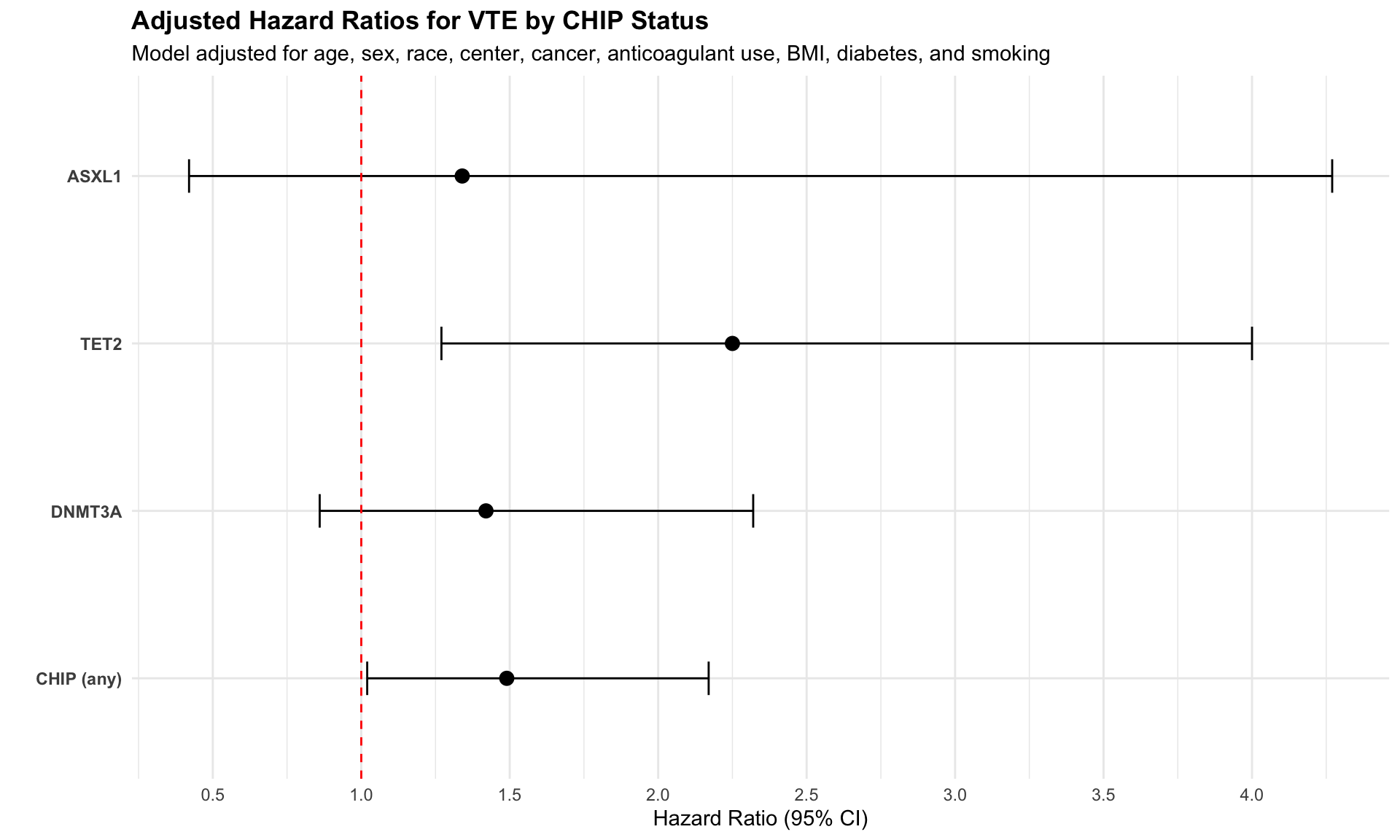
13.4 Kaplan-Meier Survival Curves
13.5 Conclusions
Main finding: CHIP is associated with a modestly increased risk of VTE in older adults (HR 1.49, 95% CI 1.02-2.17, P=0.038)
Gene-specific findings:
- TET2 mutations showed the strongest association (HR 2.25, 95% CI 1.27-4.00, P=0.006)
- DNMT3A and ASXL1 showed non-significant associations
Clinical implications:
- VTE could be considered in composite outcomes for future CHIP clinical trials
- Routine CHIP screening is not warranted for VTE patients at this time
- Potential mechanistic links between TET2 mutations and thrombosis warrant further research
Strengths: Well-characterized cohort, expert-adjudicated VTE outcomes
Limitations: Observational design, relatively small sample size, inability to study JAK2-driven CHIP due to low prevalence
13.6 References
Saadatagah S, Kim RB, Sukumar S, et al. Clonal Hematopoiesis of Indeterminate Potential (CHIP) and Incidence of Venous Thromboembolism in Older Adults. Journal of Thrombosis and Haemostasis. 2025. https://doi.org/10.1016/j.jtha.2025.03.042